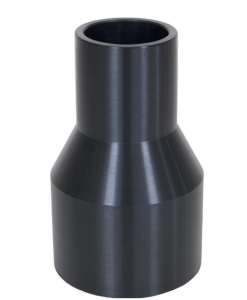
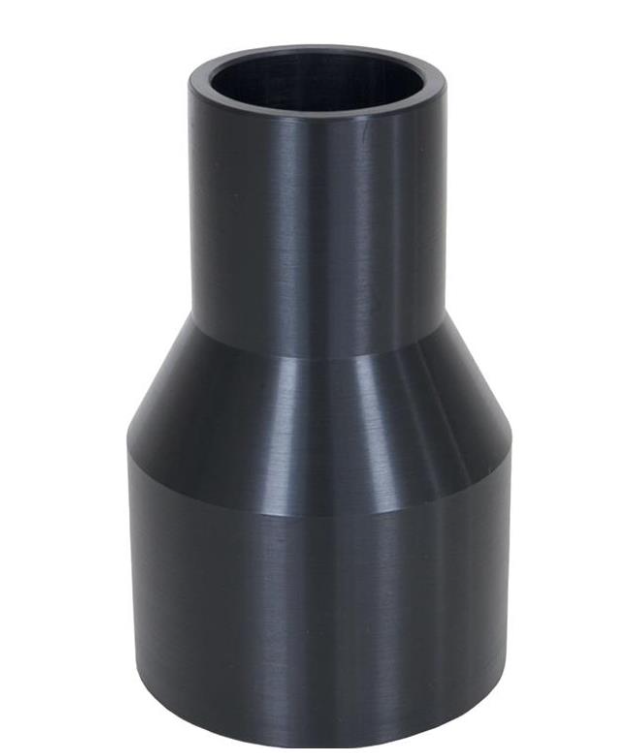
HDPE Reducers: Seamlessly Changing Pipe Diameter
HDPE Reducers are indispensable fittings in any polyethylene (PE) piping system, serving the critical function of smoothly connecting pipes of different diameters. Whether in municipal water distribution, gas transmission, or industrial fluid handling, a reliable reducer ensures continuity of flow and maintains system integrity when transitioning from a larger main line to a smaller branch, or vice versa.
What Makes HDPE Reducers Essential?
High-Density Polyethylene (HDPE) is the material of choice for infrastructure due to its exceptional durability, corrosion resistance, and flexibility. When a pipeline design requires a change in pipe size, an HDPE reducer is used to transition the flow while preventing turbulence, pressure loss, or stress concentration.
HDPE reducers are typically manufactured as molded fittings, meaning they are produced under high heat and pressure, resulting in a single, seamless piece of material. This manufacturing process eliminates potential weak points and ensures the fitting is chemically and mechanically homogeneous with the pipe itself.
Types of HDPE Reducers
HDPE reducers come in two primary geometries, each serving a specific purpose related to flow dynamics and installation:
- Concentric Reducers:
- The center axes of the two ends are aligned (concentric).
- They look like a cone and are suitable for joining pipes where the center line does not need to be maintained at the same level (e.g., vertical runs).
- They are commonly used in water and non-critical process applications.
- Eccentric Reducers:
- The center axes of the two ends are offset (eccentric).
- They have one side flattened.
- This design is crucial for maintaining a level pipe bottom (e.g., in horizontal pumping applications to prevent air pockets) or a level pipe top (for gravity drains). They are also essential when connecting to pumps or valves near a floor/wall.
Joining Methods and Reliability
HDPE reducers are predominantly installed using thermal fusion methods to create a leak-tight, permanent joint:
- Butt Fusion: The ends of the reducer and the pipe are heated simultaneously on a fusion plate and brought together under controlled pressure to form a homogeneous weld. This is the most common and robust method for large-diameter reducers.
- Electrofusion (EF): For smaller sizes, an EF coupling or a reduction coupling can be used to incorporate the reducer into the line, offering easy installation in confined spaces.
By utilizing these fusion techniques, the resulting joint is as strong as, or stronger than, the parent pipe material, ensuring the long-term reliability of the entire system. Investing in quality HDPE pipe reducer is key to minimizing friction loss and optimizing fluid flow efficiency.